12 August 2026 · Iceland & northern Spain
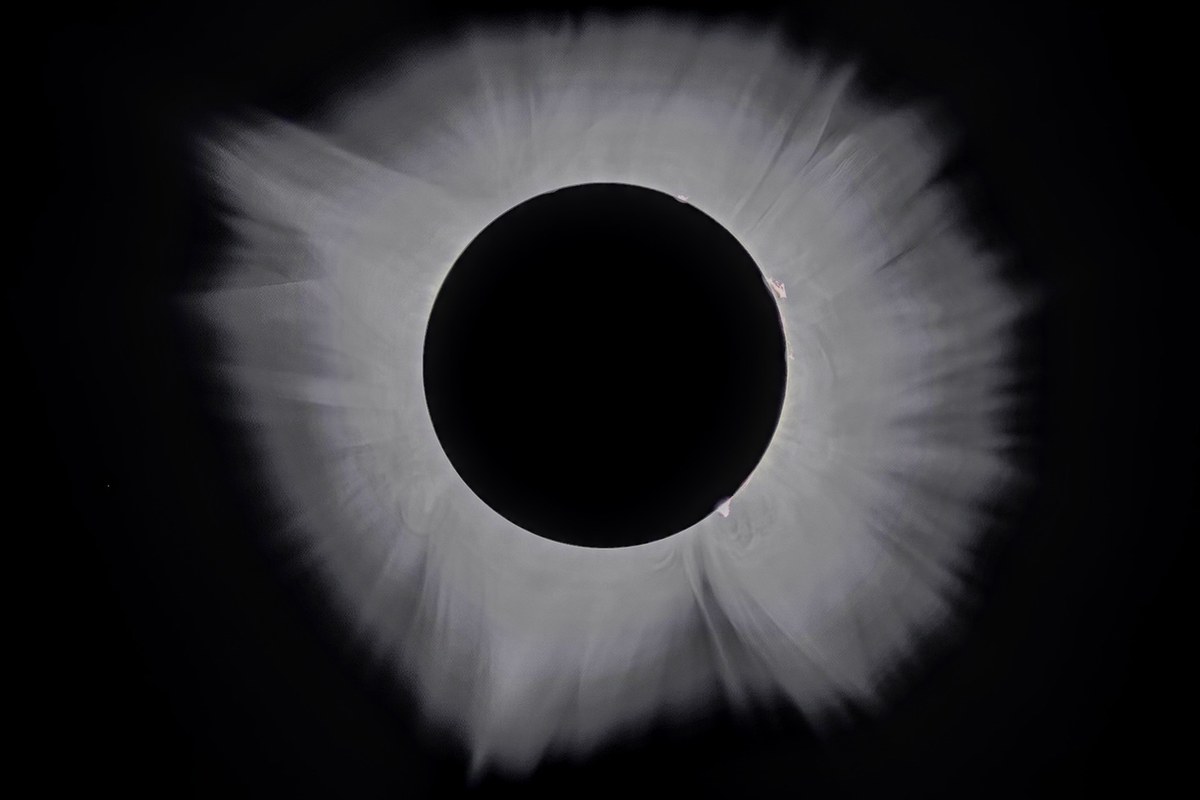
Eclipse brackets, merged into one corona.
Totality lasted about two minutes. Anyone who came home with a folder of bracketed exposures and no obvious way to turn them into the corona they actually saw could send them in — each set was merged by hand into a watermarked preview of their own image, free to see before anything was charged.
That one-off processing offer was built for a single day and has since closed.
Photo: ESO/P. Horálek/Solar Wind Sherpas project (CC BY 4.0)
The first mainland-Europe totality since 1999.
On 12 August 2026 the Moon's shadow crossed Iceland and northern Spain. There was no second attempt, no coming back next month for more data, no clear-night rescheduling. Whatever a camera recorded in those two minutes was all anyone would ever have of it — which is exactly why the processing wasn't allowed to be the part that failed.
The bit nobody warns you about
Everything on the left is what eclipse and astro imagers actually say on the forums after a shoot. Everything on the right is what this pipeline did about it.
“I bracketed correctly, but now what?”
Upload the brackets, get a finished image back. That was the entire interaction.
“PixInsight can seem daunting when new.”
Nothing to install, nothing to learn, no layer masks.
“I'll process my results about 893 times.”
One upload, one result — reprocessed by hand if wanted different.
“I'm still pretty lost.”
Nobody touched a Smart Object, a mask, or a blend mode.
A visible blending seam — that rectangular transition where the exposures were merged.
Frames were cropped to their common overlap before merging, so no seam could form.
Background sky turning cyan or magenta once you stretch it.
Fused in linear 16-bit space and neutralised per channel, so the sky stayed neutral.
The faint outer corona is simply invisible in any single exposure.
Exposure fusion recovered it. Measured on the test below: pure-black pixels fell from 18.5% to 1.3%.
What exposure fusion actually recovered
Left: one exposure on its own. Right: the same corona after the bracket is fused. Look at the outer corona — how far the streamers reach before the frame goes black.
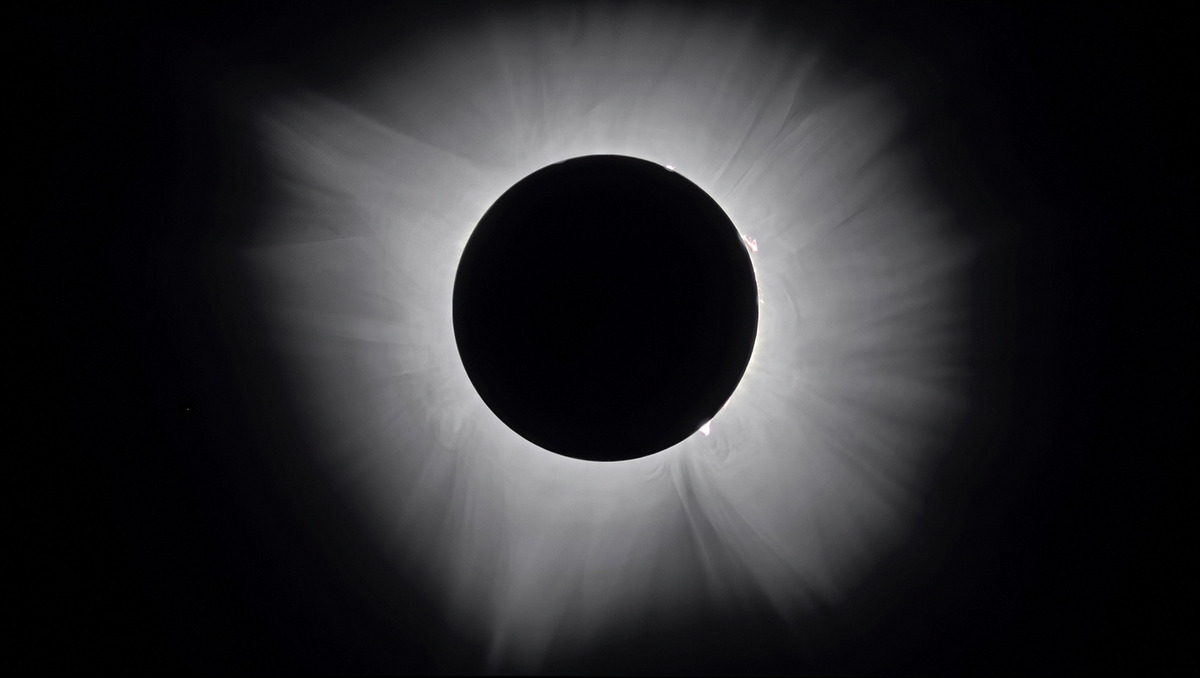
One exposure
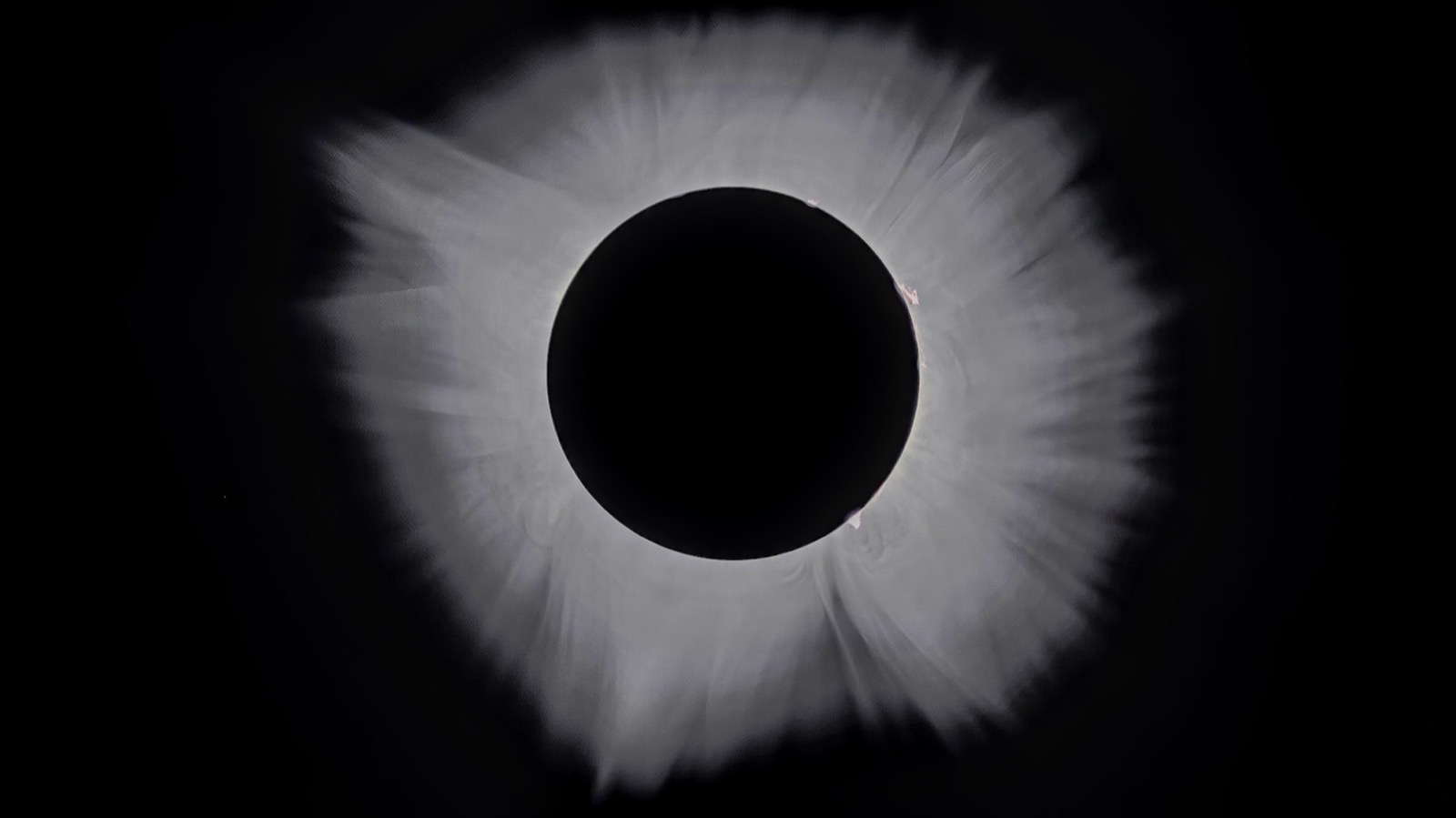
Bracket fused
Test render from a bracketed corona sequence — a synthetic bracket built from a real corona photograph to validate the pipeline. This was never customer work: the one-off corona processing offer built around this page received no real customer submissions before it closed, and has since been retired.
This was a composite, and it always said so
Each finished image was HDR-merged from several of the photographer's own exposures of the same eclipse — that is what made the outer corona visible at all, and it is the standard technique for corona work. It was never a blend of anyone else's photograph, a stock corona, or a different eclipse. Every delivery shipped with the exact recipe used, so the image's origin could be stated plainly. Undisclosed compositing is why faked eclipse images keep getting debunked; disclosed compositing is just photography.
How the offer worked, while it ran
Reserved a slot
An email address, nothing else. Free, no card.
Shot the eclipse
12 August 2026. Bracketed exposures through totality — here's how the bracket was shot.
Uploaded the brackets
JPEG or TIFF exposures, one upload link, no account.
Saw the result
Each set was processed by hand and a watermarked preview sent back within 48 hours of upload.
Pay only if it landed
Unlocking the full-resolution files was optional. If the preview didn't land, nothing was charged.
What a processed image included
Charged once, and only after a preview had already been seen.
Full-resolution image
The processed master as a TIFF, a web-ready JPG, and a square crop already sized for social.
15-second before/after clip
One exposure dissolving into the fused corona. Ready to post the day it arrived.
Two versions
One restrained and true to what the eye saw, one streamer-enhanced. Both were included.
The exact recipe
Every step applied to the frames, written out — so how the image was made could be stated precisely, or repeated.
One free reprocess
Darker, warmer, tighter, less enhanced — one hand-done redo was included at no extra cost.
Delivered in 48 hours
Counted from upload, not from the eclipse.
How the bracket was shot
The inner corona is thousands of times brighter than the outer streamers, and no single exposure holds both. What the pipeline could give back was always limited by the range actually captured on the day — so this part was on the photographer, not the pipeline.
6
stops, minimum — running the shutter all the way from 1/2000s to a full second was ideal.
This was the single most important number on the page. A real five-frame test set that spanned only four stops, with 92–97% of every frame crushed to black, gained nothing from fusing: the merged result measured worse than its own best single frame on two of three metrics. A real six-frame bracket running 1/2000s to 0.5s fused correctly and reached 4.14 solar radii of corona. The pipeline warned when a bracket spanned under six stops.
A worked example — six frames, about ten stops end to end:
- 1/2000s
- 1/500s
- 1/125s
- 1/30s
- 1/8s
- 1/2s
-
Fix aperture and ISO. Vary only the shutter speed.
Changing aperture or ISO between frames breaks the photometric chain the merge depends on. Setting them once and leaving them alone for the whole sequence was essential.
-
Span at least six stops — ideally 1/2000s to 1 second.
The short frames held the inner corona and any prominences; the long ones held the faint outer streamers. A four-stop bracket had nothing in it to recover, and no amount of processing put that back.
-
Turn off auto-exposure, auto-brightness, auto-ISO and any in-camera HDR or “night mode”.
Auto-brightening clipped every frame towards white and destroyed the very range the merge needed. It was the single biggest defect found in testing — brightened frames looked fine one by one and fused into nothing.
-
Tripod, and don't reframe between exposures.
Small drift was handled — frames were registered on the Moon's edge before anything was merged. Recomposing part-way through the bracket was not.
-
Shoot the whole bracket inside totality, with the solar filter off.
The filter came off only for totality, and went straight back on the moment the diamond ring returned — at any other time, an unfiltered lens would have permanently damaged eyes and destroyed a sensor. Frames from the partial phases — the crescents — could not be used, and the pipeline rejected them.
-
More frames across the range beat more frames at one exposure.
Totality on 12 August ran to about 2 minutes 18 seconds at best, and less from most places along the track. Ten frames at one shutter speed gave one exposure's worth of information; six spread across the range gave a corona.
-
16-bit TIFF worked best. JPEG worked too.
Shooting RAW and then exporting 16-bit TIFF with no auto-tone, no auto-exposure and no creative profile applied gave the highest quality this pipeline accepted. Plain JPEGs were fine, they simply carried less range. Camera RAW files themselves were never supported.
Processing could not invent range that was never captured
A merge could only redistribute the light the frames actually recorded. If the bracket was narrow there was nothing underneath to bring out, and hand work didn't change that — which is why this list mattered more than anything done afterwards. It stands as a record of how to shoot a bracket worth processing, whether or not this pipeline ever sees another one.
Join the waitlist
The pipeline behind this page is becoming a mobile app for shooting the moon, the aurora and the Perseids on the phone you already own. Coming to iOS. Leave your email and I'll let you know the moment it's ready — nothing else.
You're on the list.
I'll email you the moment the app is ready. Questions before then go to [email protected].
Who was actually doing this
I wrote the pipeline and sat with every single result before it went out. Each set was processed by hand, which is the honest reason turnaround stayed capped rather than open-ended. Write to me directly at [email protected].
Honest questions, honest answers
What files were accepted?
JPEG or TIFF exposure brackets of totality — three to nine exposures of the same corona at different shutter speeds was ideal. Camera RAW (CR2, NEF, ARW) was never supported: testing on it never finished before the offer closed.
Was the result a composite?
Yes, and this page said so rather than burying it in small print. Several of the photographer's own exposures of the same eclipse were HDR-merged into one image — that is the only way the faint outer corona and the bright inner corona can both appear at once. Nothing from another photograph or another eclipse was ever mixed in, and the exact recipe shipped with the files so the image's origin could be stated.
What if it was cloudy?
Then nothing was owed. Nothing was ever charged to reserve, and payment only ever applied after a preview of a real result — which couldn't exist if there was nothing to shoot. Weather risk sat with the sky, not with anyone's wallet.
What if the preview wasn't liked?
Saying so ended it there, at no charge. If it was liked but wanted different, one hand-done reprocess was included once the files were unlocked.
Did anyone actually use this?
No real customer submissions came in before the offer closed. It was a pipeline test built for one specific eclipse, and the proof on offer was always the preview of your own image before any money changed hands, plus the pipeline test shown above — not testimonials or reviews, which were never invented for this page.
How was the corona bracketed?
Fixed aperture and ISO, then the shutter run across at least six stops during totality — ideally 1/2000s up to a full second. That range was the whole ballgame: a four-stop bracket couldn't be rescued afterwards. The full seven-point version is on this page.
Why only ten slots?
Because each set was merged and judged by hand by one person on one machine, and the 48-hour turnaround was a promise rather than a hope. Eleven would have made it a lie.
Free eclipse guides: watch it safely, shoot it on an iPhone, the gear that mattered, and what totality actually was.