What is a total solar eclipse?
Totality is a different event from a partial eclipse, not just a bigger one. Here's what actually happened overhead on 12 August 2026.
By Skai · Updated 2026-08-10
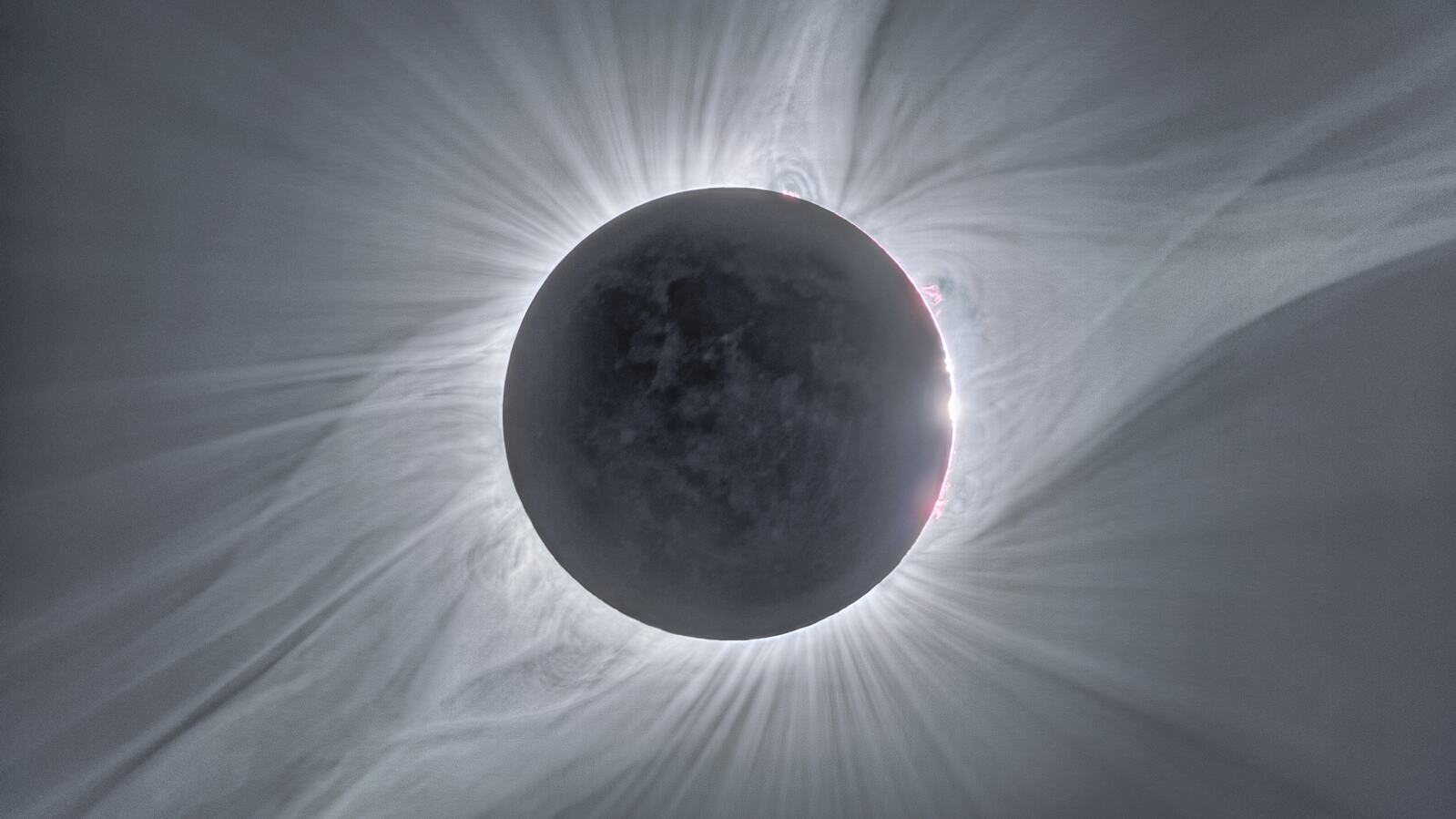
Photo: ESO/P. Horálek/Solar Wind Sherpas project (CC BY 4.0)
A solar eclipse happens when the Moon passes directly between the Earth and the Sun, so that from the ground the Moon's disc covers some or all of the Sun's disc. Most solar eclipses are partial, seen by huge stretches of a continent, and mostly unremarkable to witness: the daylight dims slightly and life goes on. A total solar eclipse is a different experience entirely, and it's worth understanding why before you plan around one.
Path of totality vs. the partial zone
The Moon's shadow on Earth has two parts. The umbra is the small, dark inner shadow. Anyone standing inside it, as it races across the surface, sees the Moon fully cover the Sun: that's totality. The penumbra is the much larger, lighter outer shadow surrounding it, and anyone inside it sees only a partial eclipse, a bite taken out of the Sun, with the size of that bite depending on how close they are to the umbra's track. The umbra's footprint on the ground, called the path of totality, is typically only 100-200km wide, even though the penumbral partial-eclipse zone can span an entire continent. Being 50km outside the path means seeing a deep partial eclipse and nothing more. Totality doesn't have a "mostly" version.
Why totality is different in kind, not degree
A 99% partial eclipse and a total eclipse sound close on paper, but they aren't the same experience. Right up until the Sun's disc is fully covered, its light is so intense that even a sliver still lights the sky like an ordinary day, and it's never safe to look at without a solar filter. The instant the disc is fully covered, everything changes at once: the sky darkens meaningfully, the temperature drops, and the Sun's outer atmosphere (the corona, normally lost in the glare of the disc) becomes visible as a pale halo streaming outward. That visibility lasts only as long as totality itself, typically a couple of minutes depending on the specific eclipse, before the Sun reappears and the effect reverses instantly. It's a different astronomical event, not an intensified partial one.
How rare totality is for one fixed place
Because the path of totality is so narrow relative to the Earth's surface, any single fixed location experiences a total solar eclipse on average only about once every 300-400 years. Total eclipses themselves aren't rare globally (one happens roughly every 18 months somewhere on Earth), but the path is usually over ocean, or over land nowhere near where most people live. That's the entire reason eclipse travel exists as a hobby: waiting for totality to come to you is, for almost everyone, waiting for something that won't happen again in a lifetime.
The 12 August 2026 eclipse
The path of totality for this eclipse crossed Greenland, Iceland and northern Spain. Most of the rest of Europe falls in the penumbra and sees a deep partial eclipse instead of totality. In the Iberian Peninsula, the eclipse falls in evening light. If you're not inside the narrow path itself, in Greenland, Iceland, or northern Spain, you will see a partial eclipse, which still requires a solar filter to view safely and doesn't include the corona, the darkened sky, or any of what makes totality distinct.
If this date doesn't work for you or you're not near the path, the next Europe-relevant totality is on 2 August 2027, crossing southernmost Spain and North Africa. Total solar eclipses aren't a once-only event for the continent. They're just genuinely infrequent for any one place, which is exactly why this explainer is worth bookmarking past this particular date.
Planning to shoot totality? Know what gear and bracket you'll need first.
Read the eclipse gear guideFrequently asked questions
What's the difference between a total and a partial solar eclipse?
In a partial eclipse the Moon covers only part of the Sun's disc, and the sky never truly darkens: you still need a solar filter to look at it safely at any point. In a total eclipse, within the narrow path of totality, the Moon fully covers the disc for a few minutes, the sky darkens, the corona becomes visible, and it is briefly safe to look without a filter. It's a difference in kind, not just degree.
What are the umbra and the penumbra?
The umbra is the Moon's inner, full shadow. Anyone standing inside it experiences totality. The penumbra is the much larger surrounding partial shadow, and anyone inside it sees a partial eclipse, with the exact fraction covered depending on how close they are to the umbra.
How rare is a total solar eclipse for one specific place?
The path of totality is only about 100-200km wide, while Earth's surface is enormous, so any single fixed location sees a total eclipse on average roughly once every 300-400 years. That's why people travel specifically to stand inside the path instead of waiting for one to come to them.
Where does the 12 August 2026 eclipse cross?
Totality crossed Greenland, Iceland and northern Spain. Most of the rest of Europe sees a deep partial eclipse instead, and in Iberia it falls in evening light. The next Europe-relevant totality after this one is on 2 August 2027, crossing southernmost Spain and North Africa.
Shooting totality yourself?
Not sure your corona bracket turned out? Run it through the free diagnosis tool and find out what's fixable.
Get your free diagnosisFree, no signup, runs in your browser.