How to watch a solar eclipse safely
This guide covers certified glasses, the free pinhole method, and exactly when it's safe to look up without protection. Read it before the sun gets involved.
By Skai · Updated 2026-08-10
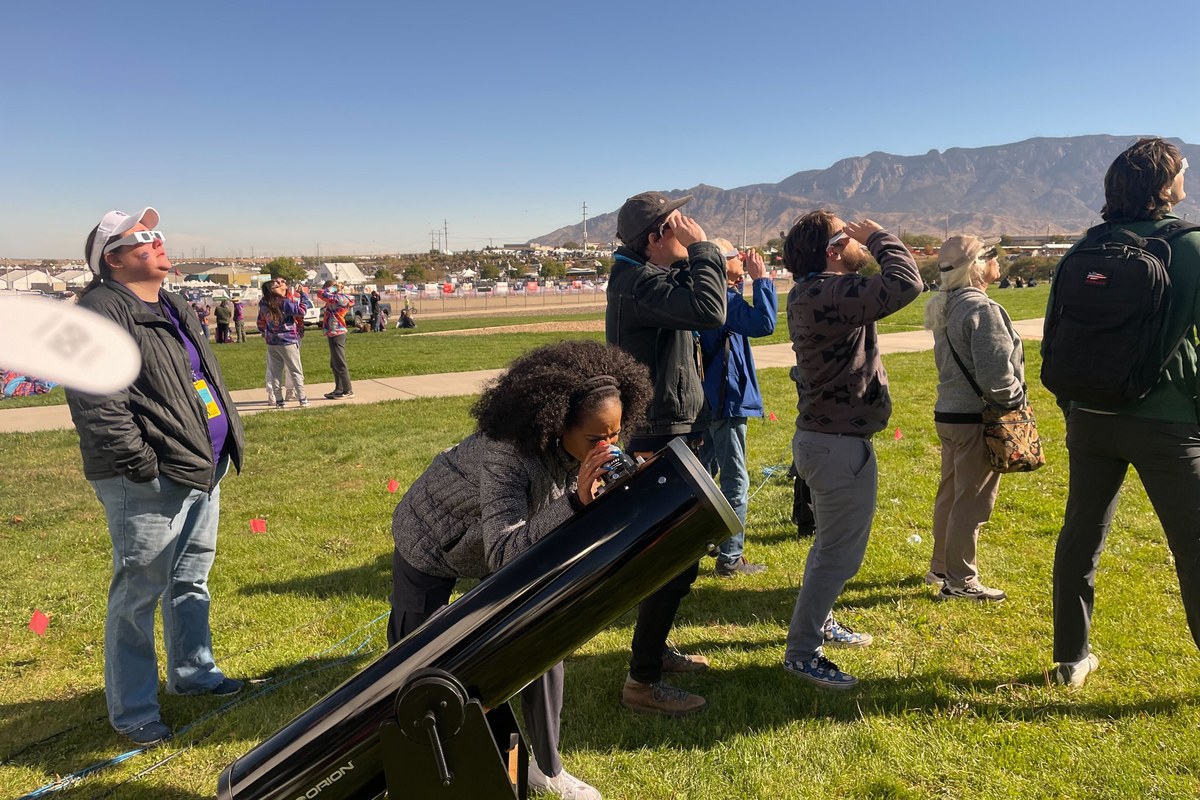
Watching the partial phases the only safe way: certified glasses, and a filter on anything with a lens. Photo: NASA SVS
A solar eclipse happens when the moon passes directly between the Earth and the sun, blocking some or all of the sun's light for a few hours from any given spot on the ground. Where the moon's shadow falls completely, viewers get totality: a few minutes of true darkness with the sun's outer atmosphere, the corona, visible around a black disc. Everywhere else in the shadow's wider path sees a partial eclipse, where the moon takes a bite out of the sun but never fully covers it. Both are worth watching, and neither is safe to watch carelessly. The sun doesn't become gentler just because part of it is covered.
Certified eclipse glasses: the standard method
Real eclipse glasses are certified to the ISO 12312-2 international safety standard, printed somewhere on the frame or packaging. They're thousands of times darker than sunglasses, blocking essentially all visible, infrared and ultraviolet light so only a safely dim image of the sun's disc gets through. Buy from a reputable source, check the glasses aren't torn, scratched or punctured before use, and if a listing doesn't mention ISO 12312-2 anywhere, skip it.
What is not safe: regular sunglasses (even several stacked), smoked glass, exposed camera film, polarizing filters, or CDs/DVDs held up to the sun. None of these block infrared and ultraviolet radiation adequately, and none of them warn you with pain while the damage happens. Solar retina damage is often painless until it's already done.
Pinhole projection: the free method
If you don't have glasses, pinhole projection needs nothing but two pieces of card. Poke a small clean hole in the first card, hold it up with your back to the sun, and let the sunlight pass through the hole onto the second card held below it. The hole projects a small image of the sun onto the second surface, showing the crescent shape during the partial phases. You never look toward the sun at any point. You only watch the projected image, and that's what makes it completely safe. A colander, or even gaps between overlapping leaves in tree shade, works the same way, often projecting dozens of crescents at once.
When the glasses come off
Glasses stay on for the entire event unless you are standing inside the path of totality and totality has actually begun: the sun fully covered, the sky visibly darker, and no bright crescent anywhere on the disc. That's the only moment it's safe to look up with the naked eye, and it's genuinely worth doing, because the corona is invisible through eclipse glasses. The instant the first bright sliver of sun reappears at the end of totality, glasses go back on immediately, without waiting to "just see a bit more." If you're watching a partial eclipse from outside the path of totality, this exception never applies. The sun is never fully covered there, so the glasses never come off.
Kids, binoculars and cameras: the same rule, amplified
Supervise children directly. Glasses only stay effective if they're actually on the child's face and not being lifted to peek. The same rule applies, amplified, to any optical device: binoculars, a telescope, or a camera lens. A filter made for naked-eye eclipse glasses is not enough on its own, because optics gather and concentrate sunlight. A beam that would only dim through a bare filter can be intense enough to crack or melt it once it's concentrated behind the eyepiece. The rule is simple: any filter for an optical device goes on the front of the lens or objective, where it blocks the light before it's concentrated, never at the eyepiece end.
Watching safely and shooting the corona are two different setups. The camera side is covered separately.
Read the phone photography guide2026-08-12: the next total solar eclipse
Totality on 12 August 2026 crossed Greenland, Iceland and northern Spain. Most of the rest of Europe sees a deep partial eclipse rather than totality, falling in the evening for Iberia. If you're inside the path of totality, the "glasses off" exception above applies to you during totality only; everywhere else, treat it as a partial eclipse: glasses on throughout, no exceptions.
Shooting it too?
Send your bracketed corona frames and find out what's salvageable — free, no signup.
Get your free diagnosisRuns in your browser — nothing uploaded.