How to photograph the Perseids meteor shower (phone or camera)
You don't need a telescope or an observatory. Just a dark sky, patient eyes, and a lot of frames. Here's how to actually come home with a meteor in a photo, whether you're shooting on a phone or a real camera.
By Skai · Updated 2026-08-10
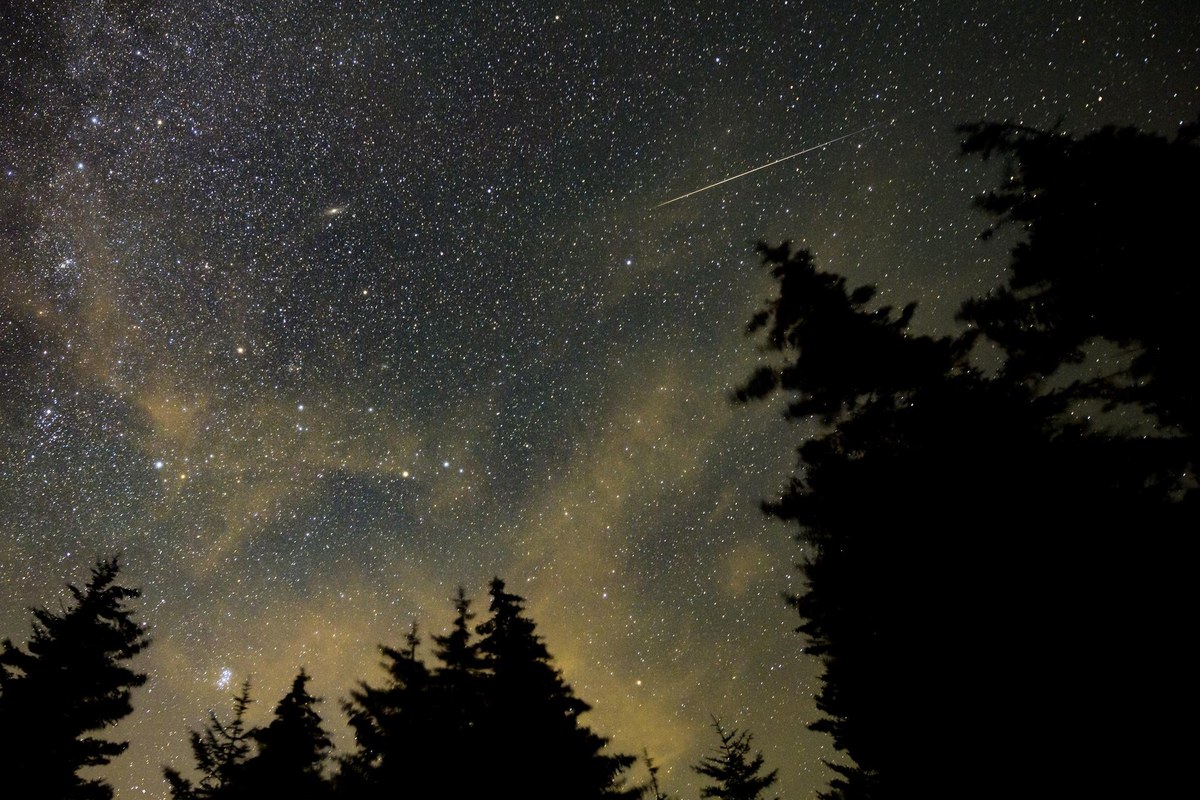
One Perseid, one frame, dark sky, no city glow: these are the conditions the guide is asking you to find. Photo: NASA/Bill Ingalls
The Perseids are one of the friendliest meteor showers for beginners. No special gear is required, and it happens every year in the middle of summer, when the nights are actually warm enough to sit outside. Photographing meteors is less about a clever technique and more about stacking the odds in your favor: darker sky, adapted eyes, wide framing, and a lot of exposures. Here's the honest version of how to do it.
Get away from city light
Light pollution is the single biggest killer of meteor visibility, more than weather or timing or gear. A meteor that would be obvious against a truly dark sky simply washes out against the orange glow of a city. You don't need a remote wilderness trip to fix this: driving even 30-45 minutes away from town, toward genuinely dark countryside, makes a bigger difference than any camera setting you could change. If you can only shoot from your backyard, face away from the brightest light dome on the horizon and shield the camera from any nearby streetlights or porch lights.
Let your eyes adapt to the dark
Your eyes need roughly 20 minutes in the dark, with no bright screens, before they're actually sensitive enough to catch the fainter meteors. Checking your phone at full brightness mid-session resets that adaptation almost instantly. Once you're set up, switch your phone to a dim red-light mode or just leave it face-down, and let your eyes settle in before you start expecting to see much. This matters for your own enjoyment of the show as much as for the photos. A lot of Perseids are faint, and adapted eyes catch far more of them than fresh-from-the-screen eyes do.
Where to look
The Perseids get their name from the constellation Perseus, which is where the shower's "radiant" sits: the point meteors appear to streak outward from. But that doesn't mean you should aim your camera at Perseus. Meteors can appear anywhere in the sky, and the ones closer to the radiant tend to look short and stubby, while the more dramatic long streaks tend to appear further away from it. Point your camera at a wide, open patch of sky, away from trees, buildings, and light domes, rather than zooming in on any one constellation. A wide field of view simply gives a meteor more sky to appear in.
Phone method
Most modern phones can do this with their built-in night mode or a long-exposure camera app. The setup matters more than the app: prop the phone completely still on a small tripod, a rock, the roof of a car, or anything that won't move for the length of an exposure. Any shake at all blurs the stars into streaks that aren't meteors.
The real trick is quantity, not one perfect shot. Take many consecutive exposures rather than a single long one. Most frames will simply be empty, with no meteor at all, so the more "rolls of the dice" you take, the better your odds that a meteor happens to streak through during one of them. Shooting in a long sequence also gives you a set of frames you can combine afterward, keeping only the ones with a meteor in them and using the rest to build a clean, star-filled background.
Camera method (for anyone with a real camera)
If you have a mirrorless or DSLR camera, the same logic applies with more control. Use a wide-angle lens to cover as much sky as possible, set the aperture around f/2.8 to let in enough light, and dial in exposures of roughly 10-20 seconds, long enough to catch a meteor's streak without star-trailing too much at a wide focal length. Push the ISO higher than you'd normally be comfortable with; a bit of noise is a fair trade for actually catching faint light.
Then set an intervalometer, or use your camera's built-in continuous or interval shooting mode, so it fires exposure after exposure automatically for as long as the battery and card hold out, ideally all night, without you touching it. This is what turns a handful of lucky attempts into hundreds of chances.
Set expectations honestly
Most frames will come back completely empty, with no meteor in them at all. That's normal, not a failure. Meteor photography is a numbers game. Rather than timing one perfect exposure to a meteor, you take enough exposures that the odds work in your favor over the course of a night.
And the "empty" frames aren't wasted, either. Dozens or hundreds of stars-only frames, stacked together, build a clean, low-noise starfield and foreground, a solid base that the rare meteor frames can sit on top of. The frame with the meteor gives you the streak; the rest of the night's frames give you the clean sky around it.
2026-08-12/13: this year's peak nights
The Perseids peak every year around 11-13 August, in the middle of a shower that's actually active for weeks either side of that. This year the peak nights fall on 12-13 August 2026, your best two nights to be out, though the nights just before and after are still worth trying if the peak is clouded out or doesn't fit your schedule. Everything above applies the same on any night you go out; the peak nights just tilt the odds a little further in your favor.
Not sure what went wrong?
Send the whole night, phone or camera or meteor frames and blank ones alike, and find out what's worth keeping — free, no signup.
Get your free diagnosisRuns in your browser — nothing uploaded.