Smart telescope vs DSLR astrophotography
One hands you a finished image before you've packed up the tripod. The other hands you raw data and a software wall to climb. Here's who each is actually for.
By Skai · Updated 2026-08-02
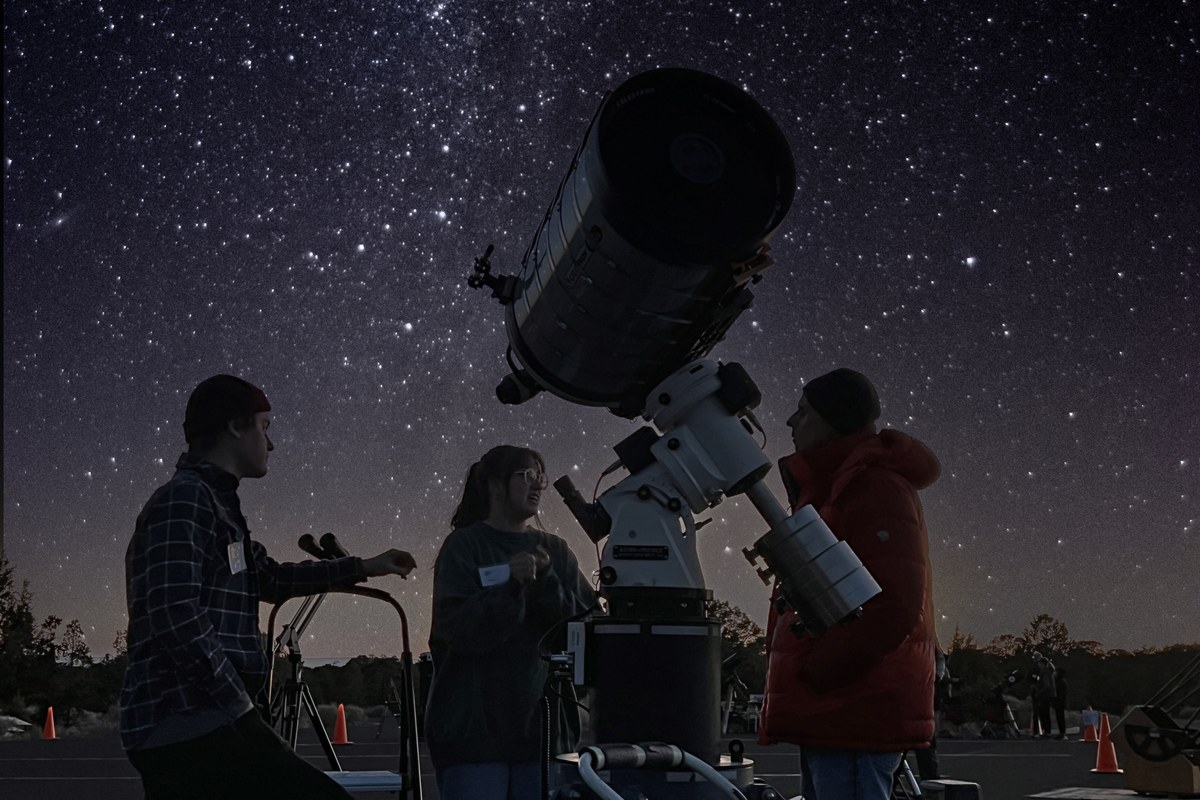
A telescope on a tracking mount: the capability a smart telescope packages up, and a bare DSLR does not have. Photo: US National Park Service
Two very different starting points
A smart telescope (Seestar, Dwarf, Vespera: an all-in-one device with a built-in camera, motorized mount and a phone app) points itself at your target, tracks it, captures exposures, and stacks them (combining many exposures into one to boost signal and cancel out noise) live, automatically, inside the app. A DSLR or mirrorless camera, whether piggybacked on a star tracker or mounted behind a separate telescope, also captures raw exposures, but that's where it stops. Stacking, calibration, and stretching (remapping the image's brightness curve to reveal faint signal) are on you, in separate software.
Neither approach is objectively better. They trade convenience for control in almost opposite directions, and which one fits depends on what you actually want out of a night under the stars.
Where the smart telescope genuinely wins
The real strength of a smart telescope isn't optical. It's the live, in-app auto-stack. While you're still standing in the yard, the app aligns and combines every new exposure into the running total, updating the preview in real time. Walk away for twenty minutes, come back, and there's a recognizable image on the screen, often good enough to share straight from your phone. You don't need DeepSkyStacker or Siril, and there's no separate calibrate/register/stack/stretch workflow to learn first. For someone who wants to see a nebula or galaxy the same night, with minimal setup and no software to install, that's a genuine advantage.
Where the DSLR / mirrorless path wins
A DSLR or mirrorless camera gives you a far higher ceiling. You choose the sensor (full-frame, APS-C, or a dedicated cooled astro camera), the lens or telescope, the exposure length and count, the filter, and how aggressively to process the final stack. Serious deep-sky imagers who stack 20-50+ hours of data across many nights are almost always running a DSLR, mirrorless, or dedicated astro camera, because smart telescopes simply aren't built for that scale of integration.
The cost of that ceiling is the "software wall": after a session, you have a folder of raw subs and nothing automated. DeepSkyStacker and Siril are both genuinely capable free tools (DeepSkyStacker for a fast, guided first stack, Siril for finer control over calibration and background handling), but calibrating, registering, stacking and stretching is a real skill with a real learning curve. It's the single biggest reason DSLR beginners abandon good data unprocessed.
Side by side
| Question | Smart telescope | DSLR / mirrorless |
|---|---|---|
| Time to first image | Same session, often under an hour | Hours to days, since processing is separate work |
| Processing workflow | Automated, live, in-app | Fully manual (DSS / Siril / PixInsight) |
| Setup complexity | Low: app-guided go-to and tracking | Higher: polar alignment, tracker, focus |
| Ultimate image ceiling | Good, but capped by fixed hardware | Highest: sensor, optics, exposure all tunable |
| Control over the final look | Limited to in-app adjustments | Total, if you learn the software |
| Best for | Fast, low-friction results | Long-term hobbyists chasing the ceiling |
Whichever gear you're on, if you don't know why the processing step keeps going wrong, find out for free.
Get your free diagnosisWho each one is actually for
A smart telescope is the right call if you want deep-sky images with the least possible friction: no tracking mount to polar-align, no stacking software to install, and a usable result the same night. It's also a strong fit for anyone who isn't sure astrophotography is a long-term hobby yet and doesn't want to invest in a full manual setup to find out.
A DSLR or mirrorless setup is the right call if you already have, or plan to build, a kit (camera, lens or telescope, tracking mount) and you want the ceiling that comes with full control, even knowing it means learning a processing workflow. It's also the only realistic path if your goal is many hours of integration across multiple nights on a single target.
There's a third group worth naming honestly: smart-telescope owners who like their gear but have started noticing that the in-app auto-stack isn't the ceiling of what their data can do. The in-app result is a fast, convenient default tuned for speed. Export your session's raw subs, though, and a deeper manual reprocess can often pull out more detail, cleaner color, and a better-controlled background than what the app gave you on the night. That reprocessing step is the same software-wall problem a DSLR shooter faces, just arriving later and by choice rather than by necessity.
Frequently asked questions
Is a smart telescope good enough for real astrophotography?
Yes, for its category. Devices like Seestar, Dwarf and Vespera auto-stack live in-app and deliver a presentable, shareable deep-sky image in one sitting, with none of the calibrate/register/stack/stretch workflow a DSLR shooter has to learn.
Will a DSLR give better images than a smart telescope?
It has a higher ceiling: more control over sensor, lens or telescope choice, and exposure strategy, but only if you also learn and run the processing workflow yourself. A DSLR with unprocessed subs and a smart telescope's in-app auto-stack can land at similar real-world results for a beginner.
Can I still get value from a done-for-you processing service if I own a smart telescope?
Yes. The in-app auto-stack is a fast, convenient default rather than the ceiling of what your raw subs can produce. Export your session's raw frames and a manual reprocess can pull out more detail, better color, and a cleaner background than the in-app result.
Do I need a separate tracking mount with a DSLR?
For anything beyond very short exposures of bright targets, yes: a star tracker or full equatorial mount keeps the sky's rotation from blurring your exposures. Without one, exposure times are limited to a few seconds before trailing appears.
Free
no signup · works with smart-telescope exports and DSLR raw frames alike
Get your free diagnosisRuns in your browser — nothing uploaded.